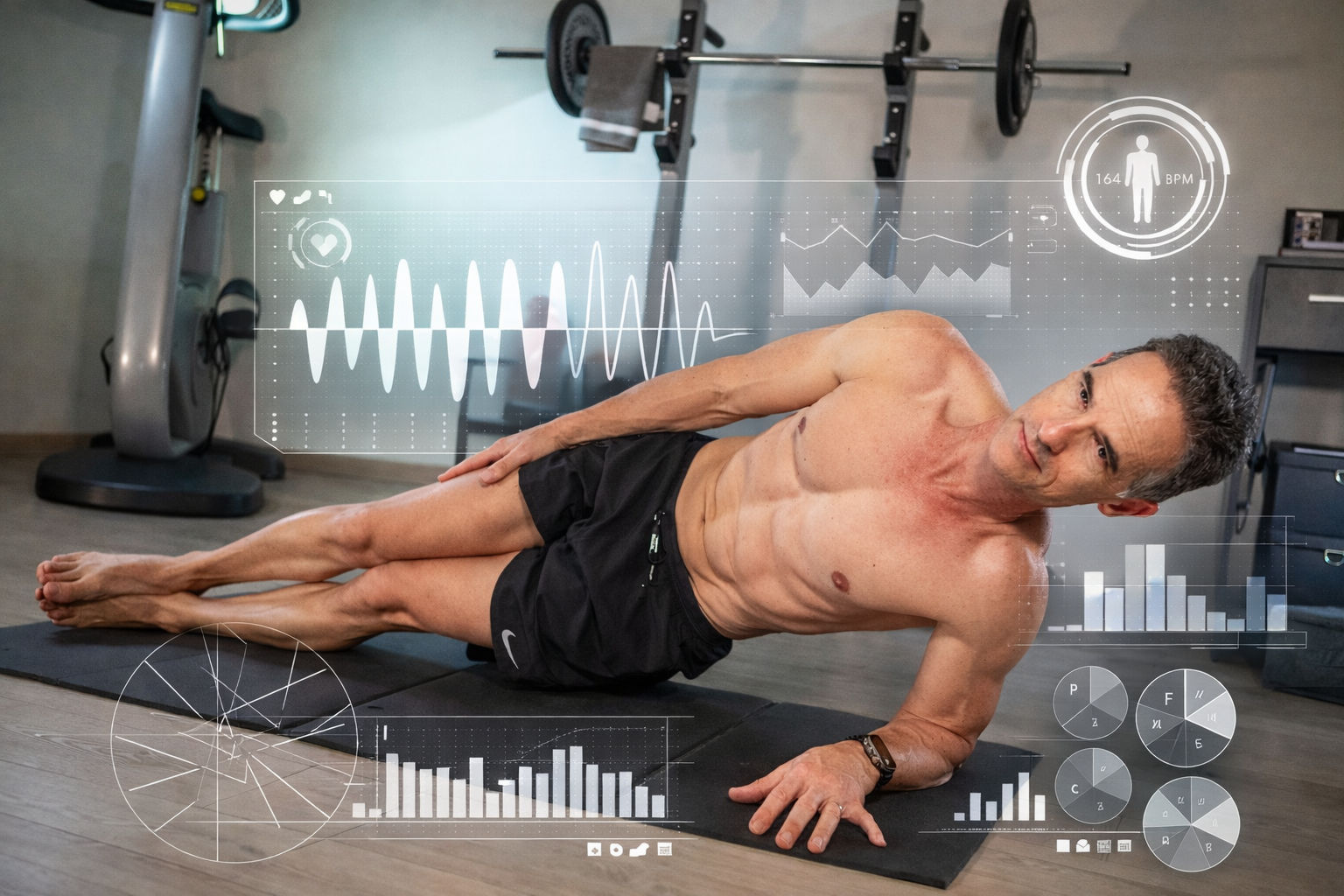

How BMR, TDEE & Macronutrients Are Calculated
Understanding the science behind determining your energy needs.
What's Behind Calculating BMR–TDEE?
Insights, research, and the importance of tracking your energy needs.
As you'll see on the BMR-TDEE Calculator page, tracking and understanding your energy needs (calories and macronutrients) is vital if you're keen on losing weight, building muscle, or simply maintaining your current condition.
It can be especially important during the first few months of a fitness journey as you get familiar with how your physiology responds.
Once you've become accustomed to your body's needs and responses, you'll find you can graduate to more intuitive eating habits.
See Tracking As a Tool, Not a Lifestyle
As I mention throughout my work, you don't have to measure and monitor every step of your fitness journey. If you've already achieved a fitness goal, you're likely well-accustomed to figuring out your nutrition and exercise needs.
Basal Metabolic Rate (BMR)
BMR is a measure of the energy needed to sustain your body's vital functions at rest (roughly two-thirds of your total energy expenditure).
BMR should not be confused with BMI (Body Mass Index), which is a measure based on mass and height. Instead, BMR measures the calories you burn while awake and inactive, which fuels:
-
Breathing
-
Blood circulation
-
Temperature regulation
-
Basic cellular functions
A more accurate measure of BMR would involve laboratory conditions and could be tested by assessing respiratory quotient (RQ), but that's not practical for everyday use. Instead, there are several formulas to estimate BMR, which are widely used in the fitness and health industry.
Total Daily Energy Expenditure (TDEE)
TDEE is the sum of all the calories your body burns over the course of 24 hours and comprises these 4 elements:
-
Basal Metabolic Rate (BMR) – The internal heat (thermogenesis) generated in driving your vital functions.
-
Thermic Effect of Food (TEF) – The energy your body uses to digest, absorb and metabolize the nutrition you consume.
-
Non-Exercise Activity Thermogenesis (NEAT) – Low-intensity movements like sitting, walking, standing, fidgeting. (NEAT is a negligible contribution to TDEE and therefore not factored into the formulas on its own, but instead taken into account as part of PAL.)
-
Physical Activity Level (PAL) – A factor of the estimated energy expended by an individual (in line with one of five levels as shown in the table below).
The Breakdown – Where Your Energy Goes
In understanding TDEE, it's important to realize how your energy output is distributed:
-
BMR: Accounts for 65-75% of your total energy expenditure.
-
TEF: About 10%, depending on what and when you eat.
-
PAL: Typically 10-30%, depending on your activity level (from sedentary to extremely active).

Formulas For Estimating BMR
There are several different models for calculating BMR. The more contemporary formulas are those established by Harris-Benedict, Mifflin-St Jeor and Katch-McArdle.
Although the Harris-Benedict formula (established in 1919) was revised in 1984, it is the Mifflin-St Jeor formula of 1990 (around 5% more accurate), which continues to be more widely accepted for general populations. The equation is:
For men:
BMR = 10 × weight (kg) + 6.25 × height (cm) – 5 × age (years) + 5
For women:
BMR = 10 × weight (kg) + 6.25 × height (cm) – 5 × age (years) – 161
The Katch-McArdle formula estimates BMR by taking "lean" body mass into account. This is ideal for athletes and lean individuals who know their body fat percentage, as it offers a more precise estimate. The equation is:
BMR = 370 + (21.6 x lean mass in kilograms).
(My calculator gives you the option of using either the Mifflin-St Jeor or Katch-McArdle formula.)
Factoring PAL Into The Equation To Get TDEE
BMR is the essential first part of calculating total daily calorie-expenditure in obtaining our TDEE.
Next, we need to factor in what we do in a day – an element known as the Physical Activity Level (PAL) – and multiply the appropriate value with our BMR.
As with calculating BMR, there are various formulas used in the industry to establish PAL. Arguably though, the most widely used method adopts the table below:

All that remains now is to multiply your BMR by an appropriate activity factor, and you have your TDEE! Your TDEE depends on your PAL, which is based on how active you are.
This page Is intended as a guide to explain the background and formulas on how to calculate BMR-TDEE. However, my calculator will give you the data in a matter of seconds!
It also provides a means to calculate your future (or adjusted) TDEE – depending on your goal, as well as your calorie and macronutrient ratios to get you there.
How To Use Your TDEE For Goal-Setting
Now that you know your TDEE, adjustments for weight loss, maintenance or muscle gain become more straightforward.
As you will see on the BMR-TDEE calculator page, it uses a 4-step process to:
-
Estimate your BMR.
-
Establish your current TDEE (according to your PAL), which indicates the calories required to maintain your weight.
-
Provide your future TDEE based on an optional pre-set or custom goal.
-
Suggest macronutrient ratios to support that fitness goal.
Guidelines
TDEE
Tracking TDEE and adjusting accordingly is a vital part of optimizing your fitness journey.
As a basic guideline for weight loss, you could consider a calorie-deficit of approximately 10% to be both safe and manageable. Muscle-gain on the other hand would require a calorie-surplus of 5% or more. Of course both these scenarios will depend on individual condition and needs.
MACRONUTRIENT RATIOS
Your macronutrient breakdown (carbs-fats-proteins) will play a key role in you achieving your fitness goals. Here's a quick high-level view of how:
-
Protein: Tissue repair/maintenance, muscle tone/gain and an additional fuel source
-
Fat: Broad range of health benefits from energy-supply to supporting organ function and acting as a buffer to diseases
-
Carbohydrates: Fuel for energy and supporting muscle protein synthesis
In terms of setting your macronutrient ratios, there are a number of factors which play a role including your body type, gender, age and of course your objective. Even though you could go with these basic guidelines, you may find that you have better or worse tolerance for fats or carbs. My best advice is to monitor and record your progress over time, and you will come to understand your metabolism and physiological tolerances.
Let's start with the protein ratio. It is commonly accepted by the fitness industry that physically active people require more protein than their non-active counterparts to support their fitness-needs. However, most fitness industry gurus tend to recommend absurd quantities of protein upwards of 1-1.5 grams per pound of body weight. On the other hand, according to the Academy of Nutrition and Dietetics, the average individual should consume 0.35 grams of protein per pound of body weight per day for general health.
There's a big difference between these two recommendations. So, how much protein is enough?
-
0.75-1 gram per pound of body weight is generally sufficient to support hypertrophy (muscle-development). Higher levels are warranted in certain cases where carbs are reduced, for example during a cutting phase.
How much fat should you consume?
-
Fat ratios are best kept between 0.35 and 0.50 grams per pound of body weight. Higher levels of fat are appropriate when carbs are reduced. Conversely, fat should be lower and carbohydrates higher for bodybuilding goals. Moderate levels of fat-intake are suitable for maintenance protocols.
What about carbohydrates?
-
After your future TDEE is established, you can select protein and fat ratios. The remaining portion of your calorie intake will go towards carbs to fit your overall energy needs.
On Tracking & Making Adjustments
-
BMR and TDEE are estimates with a natural margin of error. Use them as starting points, not absolutes.
-
As you track your progress, you'll gain more insight into your metabolism and nutritional needs.
-
Consistency is key. Regular tracking and adjusting help you stay aligned with your goals while being mindful of your lifestyle.
In Closing
Although the formulas discussed above were devised on the basis of scientifically sound procedures in testing and collecting data, one has to allow for margins of error due to research populations used, and for individual differences.
Therefore, none of the predictive equations will be free of inaccuracies or potential error. Because of this, they may be found to over or under-estimate BMR-TDEE values.
However, if consistently applied and monitored, they can be used as effective guidelines and adjusted to the individual. Establishing a metabolic set-point is of significant help in monitoring calorie-expenditure to lose, maintain or add mass.
TDEE is arguably one of the most important pieces of information when preparing to lose weight or gain muscle, so that nutrition-intake and energy-output can be effectively adjusted in line with program goals.
In plain words: you can only know where to go if you know where you are now. To get there, keep your eye firmly on your goal while sticking to your program and nutritional requirements.
Consistency is key!
References
-
Berardi, J., Andrews, R.; Nutrition: The Complete Guide, Official Course Text for ISSA's Specialist in Fitness Nutrition Program, 1st ed., International Sports Sciences Association; 2009. Unit 4, Energy Balance in the Body; p. 106-112.
-
Frankenfield, David; Roth-Yousey, Lori; Compher, Charlene (2005). Comparison of Predictive Equations for Resting Metabolic Rate in Healthy Nonobese and Obese Adults: A Systematic Review. Journal of the American Dietetic Association 105 (5): 775–789.
-
Kazaks, A.G., Stern, J.S.; Nutrition And Obesity: Assessment, Management and Prevention. 1st ed. Jones & Bartlett Learning; 2012.
-
McArdle, W.D., Katch, F.I., Katch, V.L. eds. Exercise Physiology: Energy, Nutrition and Human Performance. 4th ed. Baltimore, MD: Williams and Wilkins; 1996.
-
McArdle, W.D., Katch, F.I., Katch, V.L.; Essentials of Exercise Physiology. 3rd ed. Philadelphia, PA: Lippincott Williams and Wilkins; 2006.
-
Mifflin, M.D.; St Jeor, S.T.; Hill, L.A.; Scott, B.J.; Daugherty, S.A.; Koh, Y.O. (1990). A new predictive equation for resting energy expenditure in healthy individuals. The American journal of clinical nutrition 51 (2): 241–247.
-
Roza, A.M.; Shizgal, H.M. (1984). The Harris Benedict equation reevaluated: resting energy requirements and the body cell mass. The American Journal of Clinical Nutrition 40: 168–182.
-
Human energy requirements: Principles and Definitions. Report of a Joint FAO/WHO/UNU Expert Consultation. Food and Agriculture Organization of the United Nations (2001). Retrieved 2026-02-01.